Mapping who will control what in Yemen in 2026 | Maps news
Yemen’s internationally recognized government, known as the Presidential Command Council, says its forces did this He recovered Two strategic southern governorates, reflecting the secessionist Southern Transitional Council’s month-long hold on power.
In early December 2025, the Southern Transitional Council, a secessionist force backed by the UAE, seized the oil-rich Hadhramaut and Mahra governorates, which border Saudi Arabia, in a campaign that Riyadh described as a red line for its national security.
Recommended stories
List of 3 itemsEnd of list
Saudi Arabia, which supports the Palestinian Legislative Council, responded with a series of air strikes on STC positions, including an air strike attacks On the southern port of Mukalla, targeting what it described as UAE arms shipments to the Southern Transitional Council.
The Palestinian Legislative Council and the Southern Transitional Council have been long-time allies in the fight against the Iran-aligned Houthi rebels, who seized the Yemeni capital, Sanaa, in 2014. The recent clashes have exacerbated instability in the war-torn country and increased tensions between Saudi Arabia and the United Arab Emirates.
In this visual explainer, Al Jazeera breaks down the different groups fighting for control of Yemen, detailing who controls what on the ground and what that means for the humanitarian situation of the country’s 42 million people.
Who are the main players in Yemen?
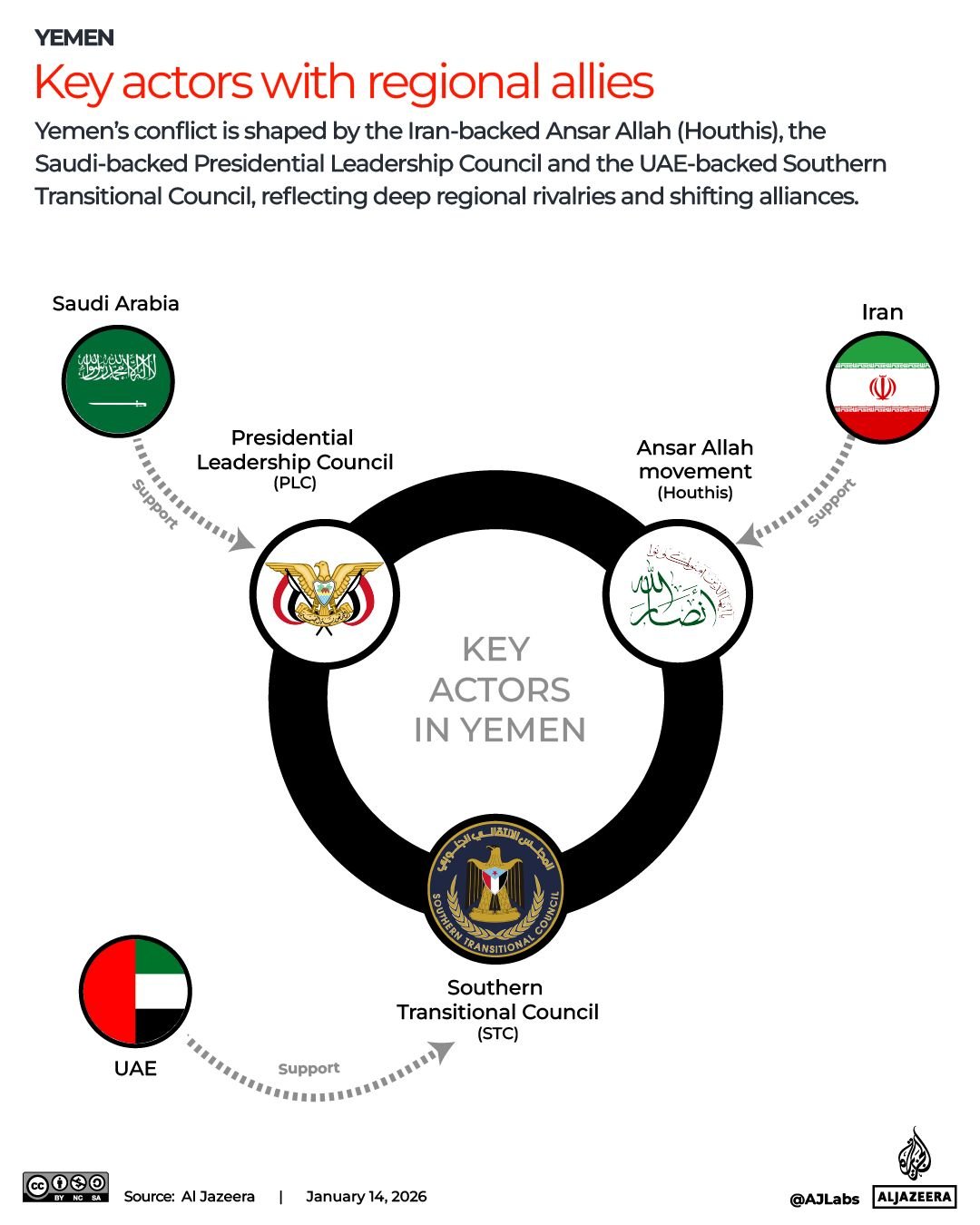
There are three main players in Yemen: the Saudi-backed Palestinian Legislative Council, the UAE-backed Southern Transitional Council, and the Iran-backed Houthis.

Presidential Leadership Council (PLC)
The Palestinian Legislative Council is Yemen’s internationally recognized, Saudi-backed ruling body, headquartered in Aden.
The group has been led by Rashad al-Alimi since 2022, after former President Abd Rabbuh Mansour Hadi officially transferred his powers to the new eight-member body, which was created to unite the various factions fighting the Houthis.
The council consists of a mix of northern and southern political and military leaders. While the Southern Transitional Council was included when it was established in 2022 to unite anti-Houthi forces, this alliance collapsed on January 7, 2026, when the Legislative Council expelled the leadership of the Southern Transitional Council after they attempted to seize the country’s eastern oil provinces.
The Legislative Council’s mission is to manage Yemen’s political, security and military affairs during the transitional period and guide negotiations towards a permanent ceasefire.

Southern Transitional Council
The UAE-backed Southern Transitional Council has undergone major changes over the past few weeks, leaving its future uncertain.
The group, which initially supported the internationally recognized Yemeni government against the Houthi rebels in northern Yemen, seeks to establish an independent state in southern Yemen, like South Yemen before the unification of the country in 1990, under former President Ali Abdullah Saleh.
On January 7, the internationally recognized Yemeni government announced that the leader of the Southern Transitional Council, Aidaroos Al-Zubaidi, had committed the crime of high treason and was dismissed from the Presidential Leadership Council.
Instead of attending a meeting in Riyadh, Al-Zubaidi dramatically fled the country on January 8, reportedly heading to the United Arab Emirates via Somaliland.
On January 9, a delegation of members of the Southern Transitional Council in Riyadh announced the dissolution of the group. But an official in Yemen’s Southern Transitional Council rejected this announcement, telling Al Jazeera that members of the delegation in Riyadh were “forced” to make the statement.
Saudi Arabia plans to host a conference of major political factions from the south to shape the future of Yemen.

The Houthis
Ansar Allah, commonly referred to as the Houthis, is an armed group trained and supported by Iran, which controls a large area in the north and west of the country, including the capital, Sanaa.
The Houthis emerged in the 1990s, but rose to international prominence in 2014, when the group rebelled against the Yemeni government, forcing it to step down.
The group then spent years, with support from Iran, fighting a military coalition led by Saudi Arabia, which has been largely frozen since a UN-brokered truce in April 2022.
The Houthis control several strategic locations along the Red Sea, including the main port of Hodeidah, giving them influence over the Bab al-Mandab Strait, which is vital for global shipping.
In November 2023, the Houthis began targeting civilian and military vessels in the Red Sea suspected of having ties to Israel, a campaign aimed at pressuring Israel to stop the genocidal war in Gaza, which began on October 7, 2023. They also launched several missile and drone attacks against Israel, with several strikes reportedly hitting their intended targets.
Who controls what on Earth?
The Houthis control the northwestern regions of Yemen, including the capital, Sanaa, while the Yemeni government controls most of the rest of the country. The map below highlights who controls what in Yemen based on data from the Sanaa Center for Strategic Studies, an independent think tank focused on Yemen and the surrounding region.
The government claims to control Aden and other parts of southern Yemen, but STC forces remain in some areas. The government also announced that all anti-Houthi military forces, including the National Resistance Forces, will now be integrated into the Yemeni army, but this process has not yet begun.

The humanitarian situation in Yemen
Yemen continues to suffer from one of the world’s worst humanitarian emergencies, with severe malnutrition, food shortages and collapsing infrastructure affecting millions.
The United Nations Children’s Fund (UNICEF) said that a decade of conflict, economic crisis, lack of social services and the ability to work has led millions of children to suffer from acute malnutrition and dozens of diseases.
Despite a fragile truce in 2022, which reduced the number of civilian deaths, access to the most vulnerable groups was limited.
According to the United Nations, at least 17 million people, about half of Yemen’s population of 42 million, face severe food shortages.
In May 2025, the United Nations reported that 4.95 million people were facing stage 3, crisis-level food insecurity, which includes 1.5 million people facing emergency-level food insecurity, stage 4.
There are approximately 11 million children in need of humanitarian assistance, nearly 20 million people in urgent need of assistance, and nearly 4.8 million people displaced from their homes since 2015.

(Tags for translation) News









Post Comment