Trump pledges to take very strong action if Iran executes protesters

President Donald Trump said the US would take “very strong action” against Iran if it executed protesters, as human rights groups say more than 2,400 anti-government protesters have been killed in a violent crackdown by Iranian authorities.
Relatives of Irfan Soltani, 26, who was arrested last week, told BBC Persian that he is scheduled to be executed on Wednesday.
A representative of the Hengawu Human Rights Organization told the BBC that they had “never seen a case move so quickly.”
Speaking to CBS News, the BBC’s US partner, Trump said: “If they hang them, you will see some things… We will take very strong action if they do such a thing.”
Soltani’s relative told BBC Persian that an Iranian court issued the death sentence “in a very quick process, in just two days.”
Oyar Shekhi, a representative for Hengaw, said the case showed that the Iranian government “is using every tactic it knows to oppress people and spread fear.”
An Iranian official told Reuters that 2,000 people were killed but that “terrorists” were responsible.
Trump had previously said that he intended to attend a meeting at the White House on Tuesday evening to discuss the situation in Iran, pledging to obtain “accurate numbers” on the number of deaths in the protests.
The US-based Human Rights Activists News Agency (Hrana) said it had so far confirmed the deaths of 2,403 protesters, as well as 12 children, despite the internet outage. The group said nearly 150 people affiliated with the government were also killed.
“The killing appears to be significant, but we don’t know that for sure yet,” Trump told reporters as he returned to the White House.
Once he has the numbers, he said, “we will act accordingly.”
Earlier on Tuesday, Trump wrote on his Truth Social platform that Iranian authorities “will pay a heavy price” for the killings, and urged people to “continue protesting.”
“I have canceled all meetings with Iranian officials until the senseless killing of protesters stops. Help is on the way. MIGA!!!,” he added, using the abbreviation for the US-based Iranian opposition’s slogan, “Make Iran Great Again.”
Trump has been considering military and other options in response to the crackdown, having already announced 25% tariffs on any country that trades with Iran.
The Iranian government responded by accusing the United States of seeking to “create a pretext for military intervention,” warning that “these rules of the game have failed before.”
The protests, which reportedly spread to 180 cities and towns in all 31 provinces, were sparked by anger over the collapse of the Iranian currency and rising costs of living.
These protests quickly expanded to include demands for political change and became one of the most serious challenges facing the religious establishment since the 1979 Islamic Revolution.
The pace of demonstrations escalated significantly last Thursday, and the authorities met them with lethal force, disguised as an almost complete shutdown of Internet and communications services.
More than 18,434 protesters were arrested during the unrest, according to HRANA.
It is difficult to gauge the true scale of the bloodshed because the BBC, like other international news organisations, is unable to report from inside the country.
However, videos posted online on Sunday showed people searching for the bodies of their loved ones at the Kahrizak Forensic Center in Tehran. The BBC counted at least 180 bodies and body bags in the footage.
About 50 bodies were seen in another video from the facility shared on Monday.
One activist told BBC Persian on Monday: “My friend went there (Kahrizak) to look for his brother, and he forgot his grief.”
“They piled up bodies from every neighborhood, like Saadat Abad, Nazi Abad, Satrakhan. So you go to your pile of addresses and look there. You don’t know a fraction of the level of violence that was used.”
It was also reported that hospitals in the capital were overwhelmed with the number of victims.
Professor Shahram Kordasti, an Iranian oncologist based in London, told the BBC’s Newsday program on Tuesday that the last message he received from a colleague in Tehran said: “In most hospitals, it looks like a war zone. We are short of supplies, we are short of blood.”
He added that other doctors in “two or three hospitals” said they had treated hundreds of wounded or dead.
An Iranian living in Rasht, near the coast of the Caspian Sea, described the city as unrecognizable. “Every place is burned with fire,” they said.
The Office of the United Nations High Commissioner for Human Rights, Volker Türk, said it urged the Iranian authorities to immediately stop all forms of violence and repression against peaceful demonstrators.
He added that describing demonstrators as “terrorists” to justify violence is unacceptable and that it is “deeply disturbing” to see statements by Iranian officials indicating the possibility of using the death penalty against demonstrators through expedited trials.

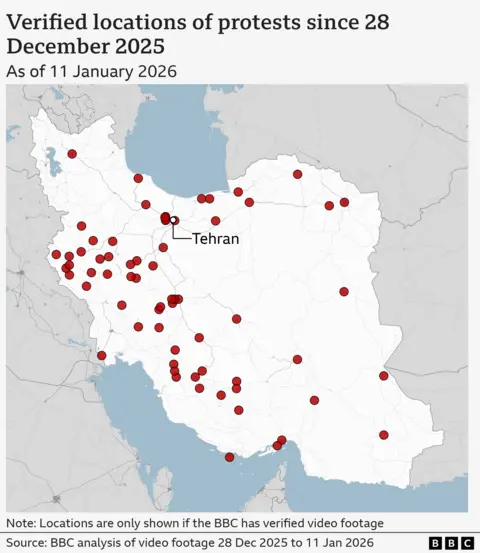
Iranian judiciary chief Gholam Hossein Mohseni Eighi said on Monday that those involved in the unrest “will be dealt with seriously and strictly.” Prosecutors said some would be charged with “waging war against God,” a national security crime punishable by death.
Turk also called on Iranian authorities to restore full access to the Internet and other communications services.
Some international calls went through from Iran on Tuesday, but the internet outage has now exceeded 120 hours, according to NetBlocks.
A person who lives near Tehran and can be reached via the Starlink satellite service told BBC Persian that there are “checkpoints in every building”, where cars and their occupants’ phones are searched by security forces.
New videos of the protests have also emerged in recent days, with BBC Persian verifying those filmed in the central city of Arak and the western cities of Tabriz, Urmia and Khorramabad.
And in the footage from Khorramabad, Gunfire could be heard during clashes between security forces and demonstrators, some of whom were throwing stones.
The demonstrators chanted slogans “Death to the dictator” – a reference to Ayatollah Khamenei – and “Reza Shah, may God have mercy on him” – a reference to the late King Mohammad Reza Pahlavi, who was overthrown in the 1979 revolution and whose son Reza lives in exile.






Post Comment